Works/Projects
A Secure Sandbox for Pre-Clinical Evaluation of LLM in Patient Portal Message Management
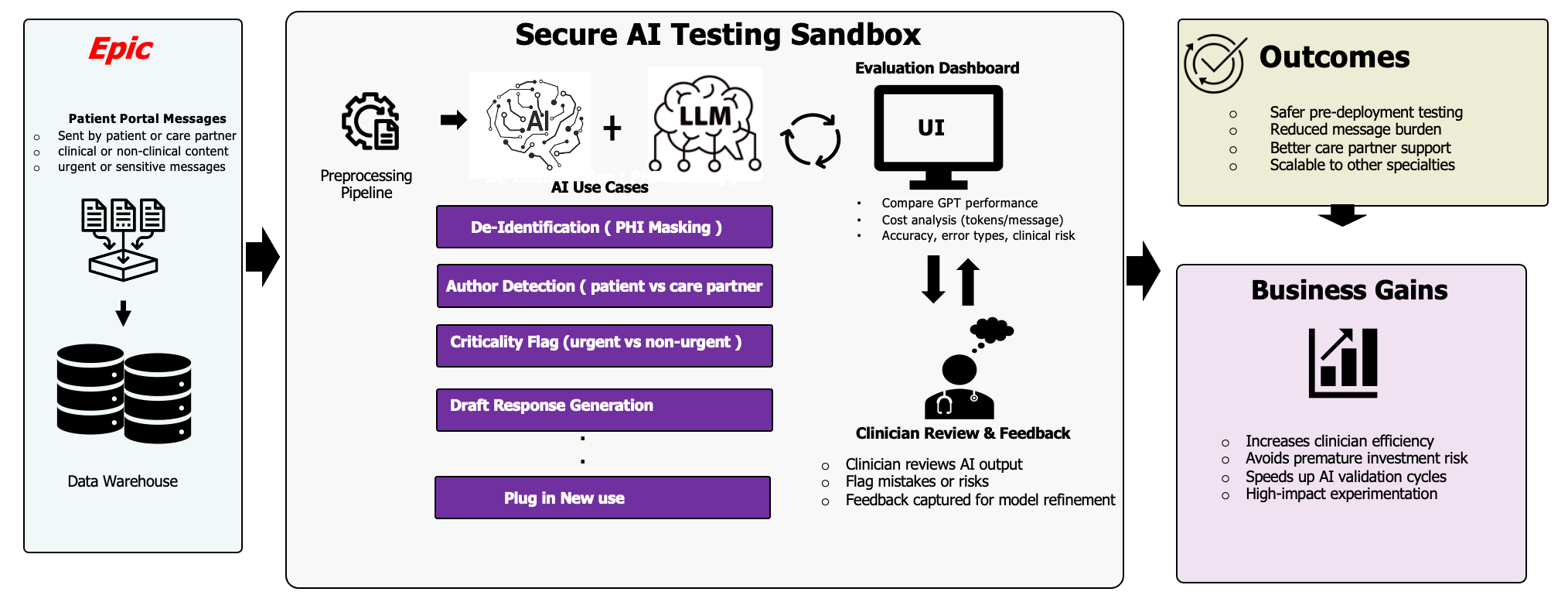
Delivered a secure AI testing sandbox that enables healthcare teams to safely evaluate large language models(LLMs) for patient portal message triage before clinical deployment. It’s developed in collaboration with Johns Hopkins Bayview Medical Center and a faculty member from the Johns Hopkins School of Nursing, using IRB-approved data.
More Details
Built with Python 3.12, Streamlit, and Azure OpenAI API, the platform processes de-identified IRB-approved patient-clinician messages to support authorship detection, message prioritization, criticality assessment, and AI-assisted response drafting, with particular focus on dementia care communication. The framework demonstrates a practical pathway for responsible AI adoption in healthcare by reducing deployment risk, maintaining clinician oversight, and enabling evidence-based evaluation of AI tools in sensitive clinical contexts.

Advanced Deep Learning–Based Automated Weld Quality and Defect Detection for Industrial Applications
Engineered a production ready an automated weld quality and defect detection system for industrial visual inspection using a customized YOLOv12-based object detection pipeline. Trained on 2,151 annotated weld images (5,937 labeled instances across Good Weld, Bad Weld, and Defect), the model performs multi-class localization under realistic surface and lighting variation. I put together the end-to-end workflow, data preparation, training, evaluation, and visual review, then packaged the results into a clear inspection-ready output (bounding boxes + class labels) that can support real-time Quality Assurance(QA).
More Details
Built with Python 3.12, Streamlit, and Azure OpenAI GPT-4, the platform processes de-identified IRB-approved patient-clinician messages to support authorship detection, message prioritization, criticality assessment, and AI-assisted response drafting, with particular focus on dementia care communication. The framework demonstrates a practical pathway for responsible AI adoption in healthcare by reducing deployment risk, maintaining clinician oversight, and enabling evidence-based evaluation of AI tools in sensitive clinical contexts.
RAG-Enabled Predictive Analytics Assistant for Design Decision Support
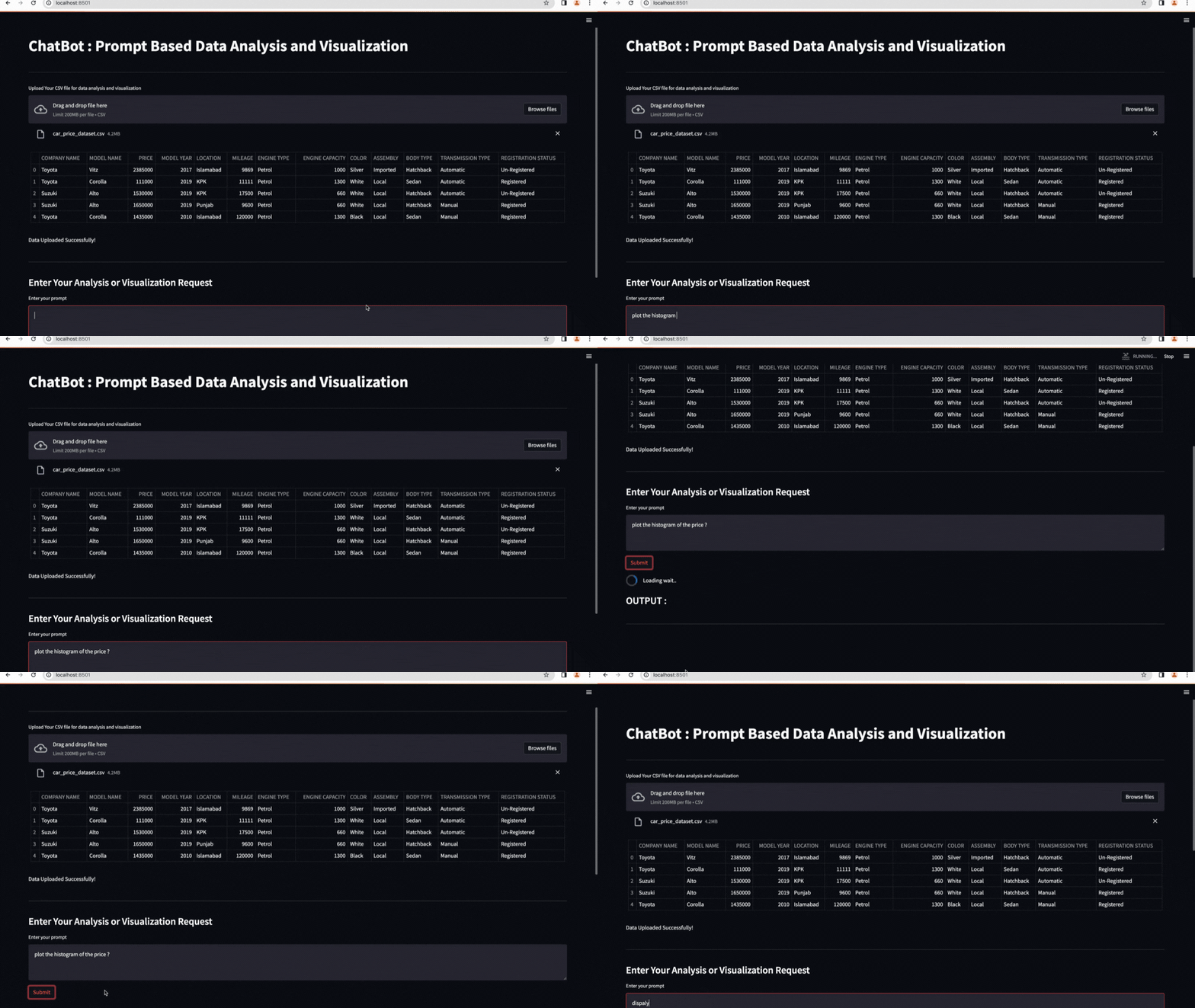
Built a prototype “AI analyst” to automate data analysis and prediction workflows that used to take teams hours of manual clicking through input tabs and rerunning models. The app lets users ask questions in plain English, generates the right dataframe/model queries under the hood, and returns analysis, plots, and prediction summaries through a lightweight Streamlit UI. On top of that, it stores key results as searchable metadata and uses a RAG-style retrieval layer so future questions can reference past runs, assumptions, and similar cases, making it easier to compare scenarios and make faster design decisions with evidence instead of guesswork.
More Details
Built with Python 3.12, Streamlit, and Azure OpenAI GPT-4, the platform processes de-identified IRB-approved patient-clinician messages to support authorship detection, message prioritization, criticality assessment, and AI-assisted response drafting, with particular focus on dementia care communication. The framework demonstrates a practical pathway for responsible AI adoption in healthcare by reducing deployment risk, maintaining clinician oversight, and enabling evidence-based evaluation of AI tools in sensitive clinical contexts.
Predicting Immunotherapy Outcomes in Colorectal Cancer Using ML and Multi-Omic Biomarkers: Development of a Real-Time Predictive Web Application
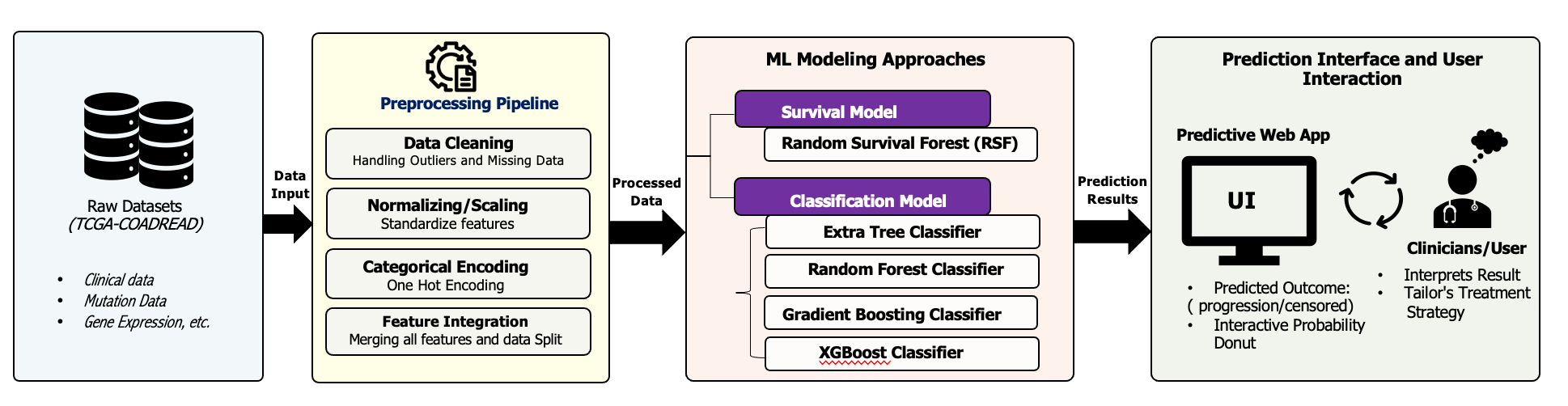
Implemented a machine learning-powered clinical decision support tool that predicts immunotherapy outcomes in colorectal cancer patients, enabling clinicians to identify high-risk patients and personalize treatment strategies. By integrating multi-omic biomarkers (genomic mutations, tumor burden, and immune signatures), the system reduces unnecessary treatment toxicity while optimizing resource allocation in oncology care. Deployed as an interactive web application, bridging computational research with real-world clinical workflows.
An Intelligent Real-Time Driver Activity Recognition System Using Spatio-Temporal Features
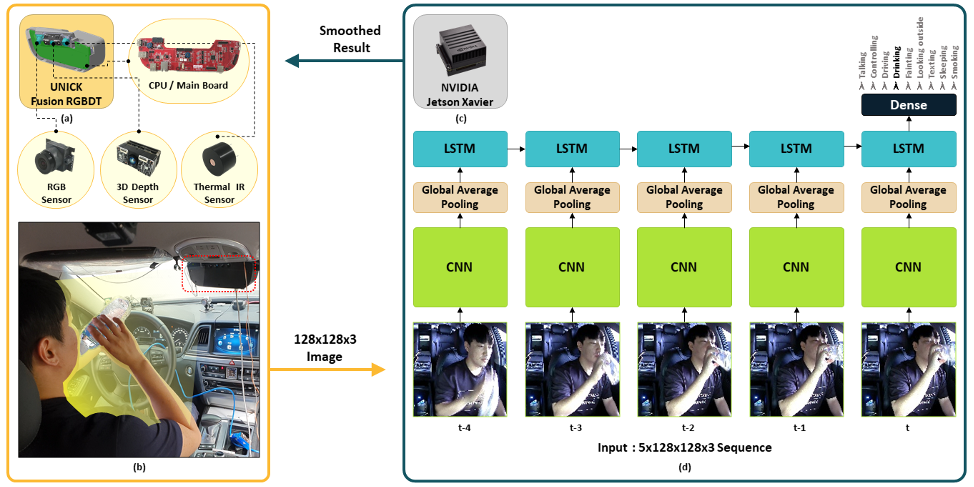
Designed and deployed an end-to-end 24/7 driver distraction detection system using hybrid deep learning (image recognition + motion pattern analysis) that operates in both daytime (RGB) and nighttime (thermal IR) conditions, recognizing 9 driver behaviors with state of the art result for nighttime distraction detection. The system was validated on 35 real drivers and deployed on NVIDIA Jetson Xavier for real-time inference (12 FPS), demonstrating production readiness for the $3B+ global ADAS market. (Fully government funded and peer reviewed research)
Contact Me
Feel free to reach out with questions, collaboration ideas, or just to connect.
Get in touch with me